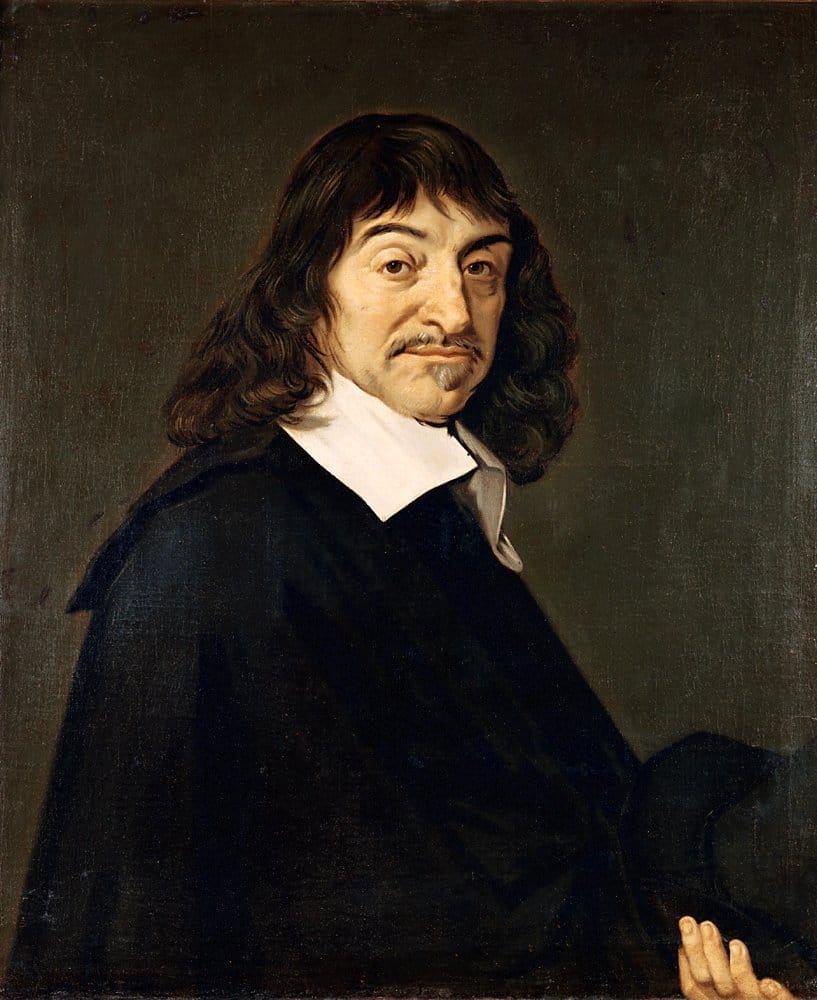
René Descartes wrote the argument known as “I think, therefore I am.” It appears in part IV of his Discourse on the Method (1637). The point is that doubting everything still involves a thinker whose existence cannot be dismissed in that very act.
Descartes is the author
The statement is associated with the philosopher René Descartes. In part IV of Discourse on the Method, he describes testing his beliefs by rejecting anything for which he can imagine grounds for doubt. The English text linked here is John Veitch’s translation.
Descartes considers unreliable senses, mistakes in reasoning and dreams that resemble waking experience. He then notices a limit to this exercise: trying to think everything false is itself an activity. Something must exist to be doing that thinking.
It is an argument about certainty
The sentence does not mean that clever people exist more fully than other people, or that pausing to think makes a body appear. It is a claim about what can be known while doubt is taken to an extreme. Even a mistaken thought still involves thinking.
Our short paraphrase is: “I may be wrong about what I perceive, but I cannot deny that this doubting is taking place without doing the thing I am denying.” That is an explanation of the argument, not a quotation from Descartes.
What about “Cogito, ergo sum”?
The familiar Latin formulation names the same argument. The Discourse was written in French; Veitch’s English version includes the Latin expression in parentheses. Distinguishing the original language, a translation and a familiar label prevents a citation from becoming more precise-looking than it actually is.
If you are quoting an English edition, identify its translator when your citation format calls for one. Do not copy wording from one translation and supply a page number from another.
Where the short answer stops
Descartes goes on to argue about the mind, the body, God and the basis of knowledge. Identifying the famous sentence does not mean all of those later arguments have been established by the sentence alone. A reader can follow the initial move and still question what comes afterward.
For a compact reference, use “René Descartes, Discourse on the Method, part IV (1637), in the translation being quoted.” That gives a reader a work and a section to examine, rather than only a famous name.