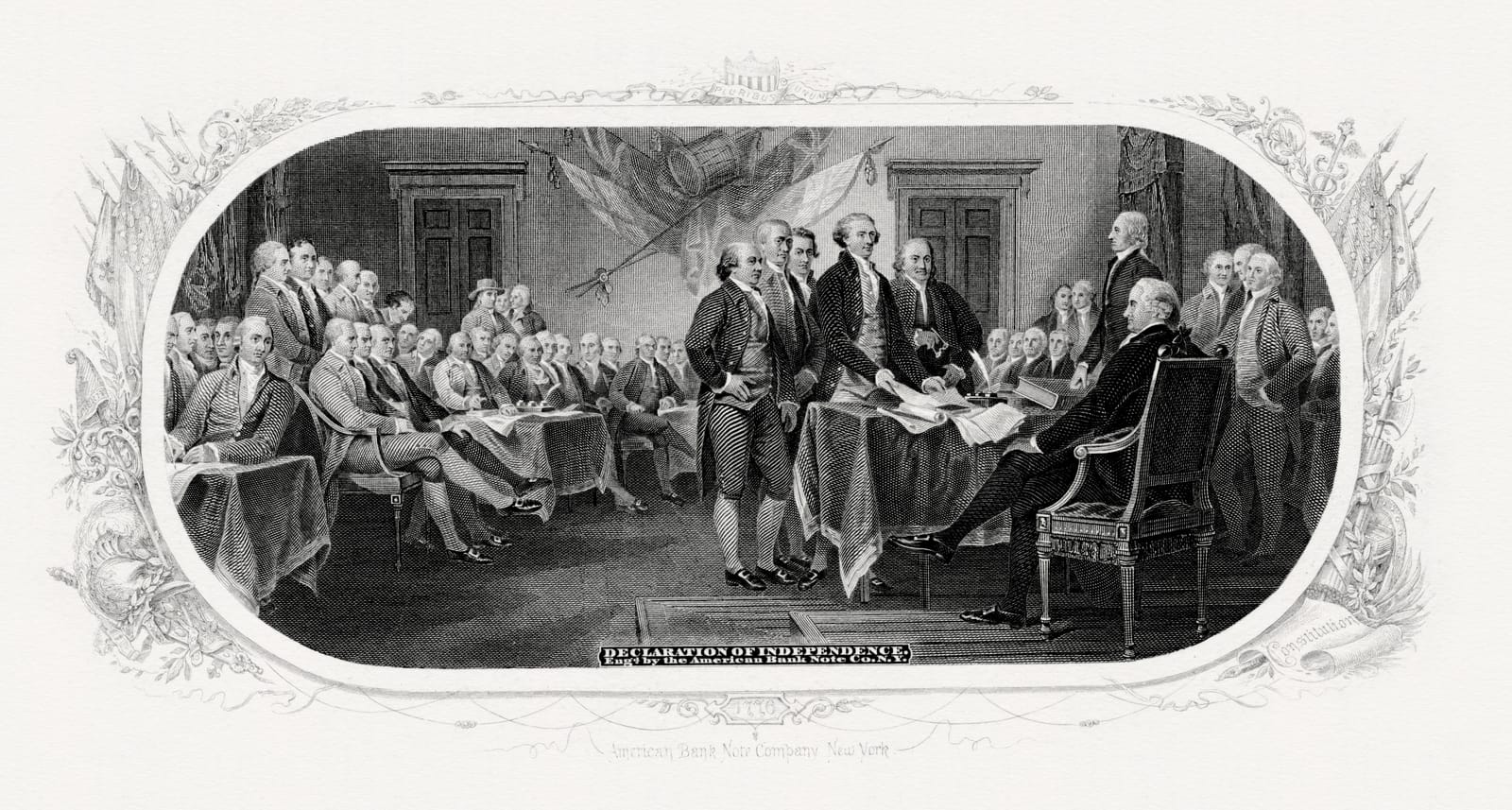
“All men are created equal” appears in the U.S. Declaration of Independence, adopted on July 4, 1776. Thomas Jefferson was its principal drafter, but the text was reviewed and changed before Congress adopted it. Citing the document is more precise than treating the phrase as an isolated spoken remark.
The source is the Declaration of Independence
You can find the phrase in the opening statement of principles in the National Archives transcription of the Declaration. The document is dated July 4, 1776. The sentence connects equality with rights and explains government as an institution intended to secure those rights.
So the best immediate reference is a written document. “Who said it?” is a natural search, but it can obscure whether the reader needs an author, a public speaker or the institution adopting a text.
Why Thomas Jefferson is the usual name
The Archives’ history of the document identifies Jefferson’s central role in drafting it. It also explains the revisions involving John Adams, Benjamin Franklin and Congress. Naming the principal drafter should not erase the process that produced the adopted declaration.
A compact attribution can therefore say: “Declaration of Independence, principally drafted by Thomas Jefferson and adopted by the Continental Congress, July 4, 1776.” That records both authorship and the public status of the final text.
Read the argument around the phrase
The document moves from a statement about human equality to rights, the purposes of government, consent and the justification for changing a destructive government. Read together, these are connected steps in an argument. The familiar six words are not a complete summary of that argument.
Our reading is that this context matters whenever the quotation is used to support a modern claim. A writer should explain how the original principle relates to the new claim, rather than assuming that inserting a famous line proves the point.
Do not confuse a stated ideal with evidence of practice
A statement of principle tells us what a document asserts. By itself it cannot establish that all the people governed under its influence experienced equality, or that every drafter applied the principle consistently. Those are historical questions requiring additional evidence about institutions and lives.
That distinction is useful even before pursuing the larger history: keep the words, the claim they make and the evidence about what actually happened separate.
A citation readers can follow
Use the document’s title and adoption date, followed by the Archives link when writing online. If you are comparing drafts, identify which draft you mean. The adopted text and the drafting history answer related but different questions.