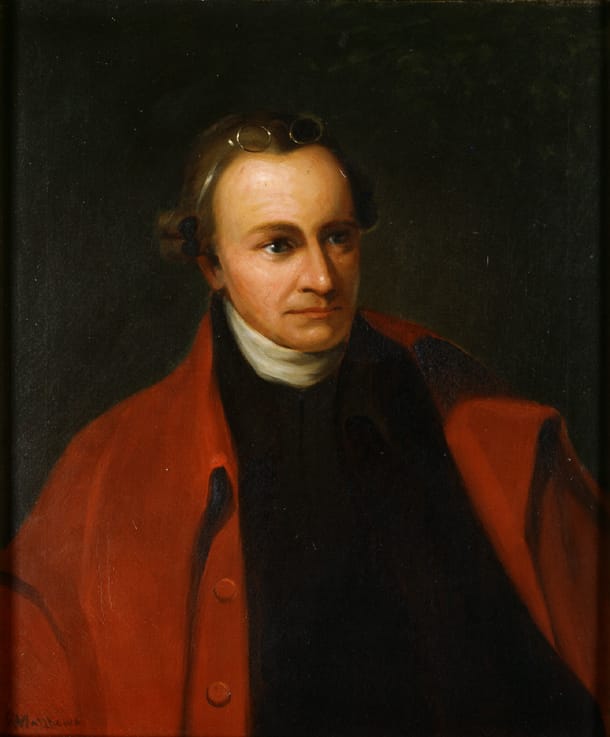
Patrick Henry is credited with “Give me liberty or give me death” from his March 23, 1775 speech to Virginia’s convention in Richmond. The familiar text comes through a later reconstruction by his biographer William Wirt, not a surviving verbatim transcript made that day.
Patrick Henry, with a source caveat
The conventional attribution is Patrick Henry, speaking at St. John’s Church in Richmond on March 23, 1775. He was addressing the Second Virginia Convention. Colonial Williamsburg’s account both reproduces the familiar speech and explains how its text reached us.
The caveat is essential: Henry’s biographer William Wirt reconstructed the account later using recollections. Wirt was not an adult observer taking down the speech in 1775. A polished transcript displayed online should not be mistaken for a contemporaneous recording.
What was Henry arguing for?
In the received text, Henry argues that delay and further appeals will not resolve the conflict with Britain. The climactic choice between liberty and death expresses his case for resistance. It belongs to a debate about what the colony should do, not simply to a collection of dramatic personal mottos.
Our reading of the rhetoric is that its final either/or formulation refuses a comfortable middle position. Whether a reader agrees with the argument or not, that structure helps explain why the ending is easier to remember than the deliberation around it.
Why the reconstruction matters
Colonial Williamsburg’s later discussion dates Wirt’s first biography to 1817. That gap changes the kind of evidence we possess. We can discuss a historically influential account of a speech while being careful about certainty over every word as delivered.
The useful distinction is not “perfect transcript or worthless history.” It is a choice of language that matches the record: credited to Henry, preserved in a later account, with the limitations stated.
How to cite it accurately
A short reference can say: “Patrick Henry, speech to the Second Virginia Convention, March 23, 1775, as reconstructed by William Wirt.” If you use a particular printed edition, add that edition’s details.
For an essay, the interesting follow-up question is how a speech’s remembered text becomes part of public memory. Looking at who preserved the words and when provides more value than repeating the ending without its source history.