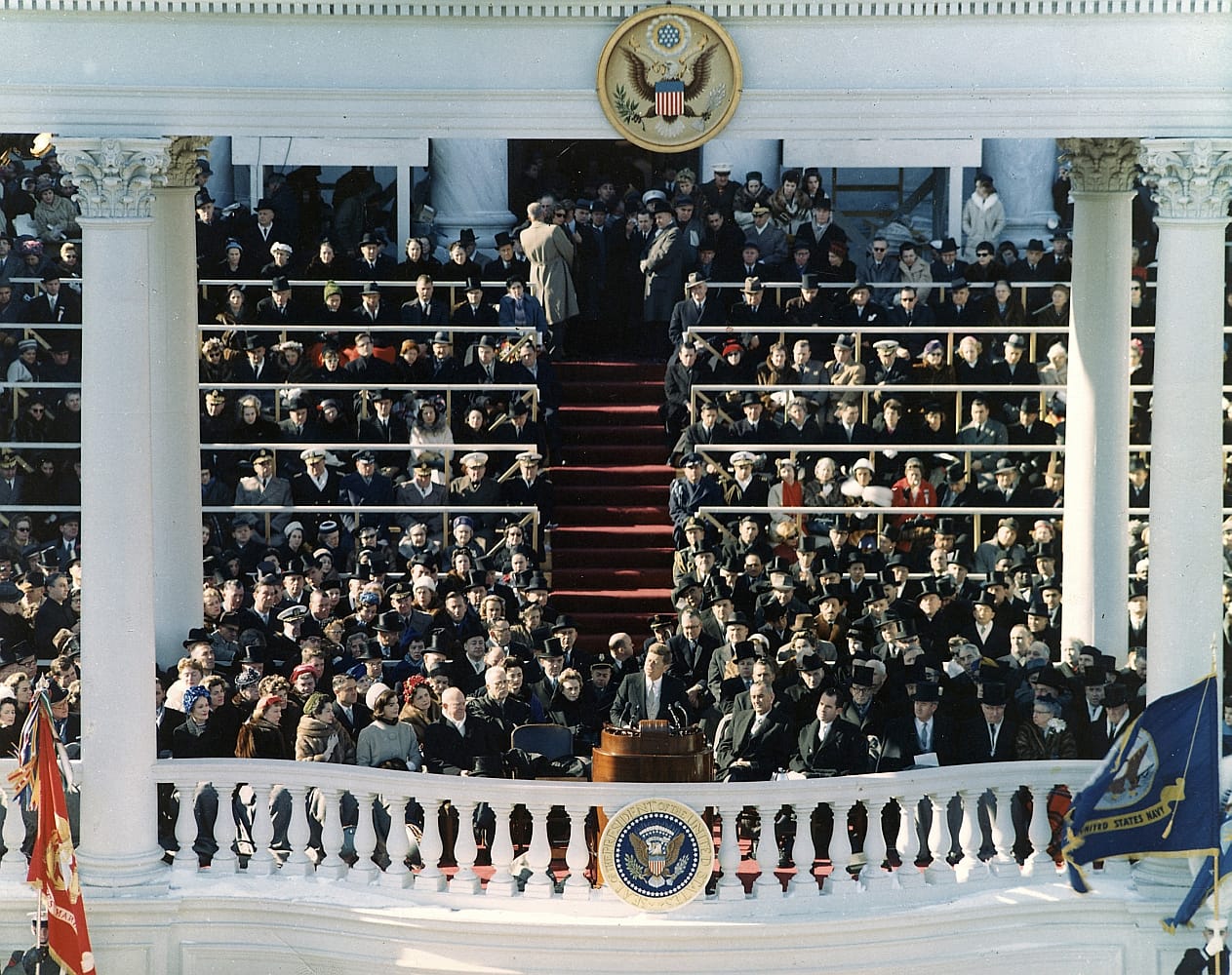
John F. Kennedy said “ask not what your country can do for you” in his inaugural address on January 20, 1961. The sentence continues by asking Americans what they can do for their country—a call to public service.
John F. Kennedy, January 20, 1961
The words come near the end of John F. Kennedy’s inaugural address. The JFK Library provides the text, allowing you to see the sentence in its place rather than as a detached quotation.
Kennedy turns a familiar question about what a country provides into a question about what a citizen contributes. Our reading is that the reversal gives the line its force: the same relationship is examined from the other direction.
What comes immediately afterward?
Kennedy then addresses people beyond the United States and asks what they and America can do together for human freedom. That next sentence broadens the appeal. The speech is not only about an individual citizen’s duty; it also imagines cooperation across national boundaries.
The address ends by asking citizens to expect the same demanding standards of the administration. Read the closing passage as a whole, and the appeal has a reciprocal element: a call for contributions from the public alongside an expectation of responsibility from government.
Who said it and who shaped it are different questions
The speaker is unambiguous: Kennedy delivered the address. For its preparation, the National Archives describes a process involving suggestions and drafts from advisers, alongside Kennedy’s repeated revisions. Its account connects the famous appeal to a theme of sacrifice he had already expressed.
That history is more informative than treating a speech as if it appeared fully formed at the microphone. It also cautions against turning a straightforward speaker attribution into an unsupported claim about the sole inventor of every phrase.
How to use the quotation in context
If you are quoting the first half, make clear that it is only the opening of the sentence. The second half supplies the positive instruction. Removing it can leave the reader with a refusal rather than the intended invitation to serve.
A compact citation is: “John F. Kennedy, inaugural address, January 20, 1961.” Add the JFK Library transcript when publishing online. The historical claim is the delivery of these words in that address; a modern argument that invokes them remains the modern writer’s argument.
For a school essay or presentation, a useful next step is to compare the two audiences in the closing passage: American citizens and citizens of the world. That comparison reveals more about the speech than a quotation poster can.