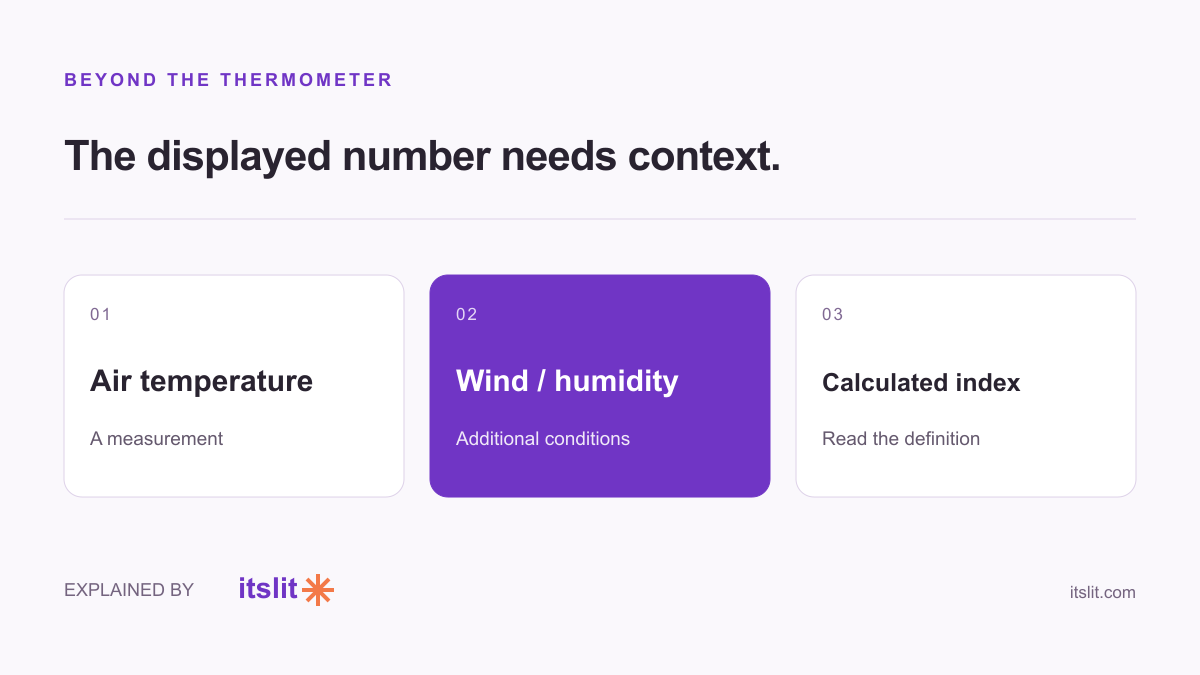
A feels-like temperature is a calculated way to describe how weather conditions can affect the experience of temperature. It is different from the air temperature alone. The Met Office's forecast guide, for example, says its feels-like value takes wind speed and humidity into account.
Two numbers can answer different questions
When a forecast shows an air temperature and a feels-like value, it isn't necessarily contradicting itself. One describes the air; the other incorporates additional conditions through a calculation.
An illustrative reading exercise: write the labels beside the numbers before comparing them. “Air: 8°C” and “feels like: 4°C” are two labeled values, not two competing measurements of the same thing. These figures are invented for the example and are not a forecast or the output of a particular formula.
In hot conditions, humidity matters
The National Weather Service's heat index combines air temperature and relative humidity. Its stated assumptions include shade and light wind. That makes the assumptions part of interpreting the number, not optional small print.
Heat index is one specific index. A number labeled feels-like should be read using that provider's explanation; the label by itself doesn't tell you which calculation was used.
For a comparison spreadsheet, keep separate columns for air temperature, humidity, index name, and calculated value. Mixing them into one temperature column would make the numbers look comparable while erasing how each was produced.
In cold conditions, wind matters
The NWS wind chill explanation describes the effect of wind and cold on heat loss from exposed skin. Its wind chill formula is defined for air temperatures at or below 50°F and wind speeds above 3 mph.
Wind chill does not mean an ordinary object becomes as cold as the wind chill number. The NWS explains that wind can cool an object toward the air temperature more quickly; wind chill alone does not lower it below that air temperature. This is why a wind chill value is not a substitute for a thermometer reading.
Read the label before the number
Check the units, the provider's definition, and whether the figure is air temperature, heat index, or wind chill. If two apps disagree, establish that they are showing the same type of value before comparing them.
This explainer decodes the terminology. It does not calculate an individual's comfort or provide exposure limits. For current conditions and alerts, use the relevant official local weather service.
Keep exploring: Understand rain probability · Compare weather forecasts.